
Artificial Intelligence: How AI Is Changing Our World
Artificial Intelligence, commonly known as AI, is one of the most exciting technologies of the modern world. From smartphones and search engines to education, business, healthcare, and creative work, AI is becoming a part of everyday life.
But what exactly is Artificial Intelligence, and why is it so important? Let’s explore it in simple words.
What Is Artificial Intelligence?
Artificial Intelligence is a technology that enables computers and machines to perform tasks that normally require human intelligence. These tasks can include understanding language, recognizing images, finding patterns, making predictions, and helping people solve problems.
AI systems learn from information and use that information to produce useful results.
How Does AI Work?
AI works through different technologies and methods. One important area is Machine Learning, where computers learn patterns from data and improve their performance.
For example, when an online platform recommends a video or product based on what you have previously watched or searched for, AI may be involved in making that recommendation.
Uses of AI in Everyday Life
AI is already being used in many areas of our daily lives.
1. Education
AI can help students understand difficult topics, practice questions, organize information, and receive personalized learning support.
2. Healthcare
AI can assist professionals in analyzing medical information and identifying patterns that may help with diagnosis and research.
3. Business
Businesses use AI for customer support, data analysis, marketing, automation, and improving services.
4. Transportation
AI can help with navigation, traffic prediction, route planning, and the development of advanced driver-assistance systems.
5. Creative Industries
AI tools can support designers, writers, video editors, and other creators by helping with ideas, organization, and certain creative tasks.
Benefits of Artificial Intelligence
AI offers several important benefits:
- Saves time by automating repetitive tasks
- Helps analyze large amounts of information
- Can improve productivity
- Supports personalized learning and services
- Helps businesses make data-informed decisions
- Provides useful assistance in many professional fields
Challenges of AI
Although AI has many benefits, it also creates challenges. AI systems can sometimes produce incorrect or misleading information. There are also important concerns about privacy, security, fairness, and responsible use of technology.
This is why people should use AI carefully and verify important information instead of accepting every AI-generated answer without checking it.
The Future of Artificial Intelligence
AI is developing rapidly and is likely to become even more integrated into education, business, science, communication, and everyday technology.
The most important skill will not simply be knowing how to use AI. People will also need to understand its limitations and learn how to use it responsibly, creatively, and thoughtfully.
1. AI in Education
AI can make education more personalized and interactive. Students may use AI-powered learning tools to understand difficult concepts, practice skills, receive feedback, and find learning resources according to their needs.
2. AI in Healthcare
Artificial Intelligence can support healthcare professionals by analyzing large amounts of information, assisting medical research, and helping identify patterns. In the future, AI may contribute to faster research and more personalized healthcare services.
3. Generative AI
Generative AI is one of the fastest-growing areas of AI. It can help create text, images, audio, video, and other digital content. These tools can support students, designers, writers, developers, and businesses in their creative work.
4. AI and Business
Businesses are increasingly using AI to automate repetitive tasks, analyze data, improve customer experiences, and make better decisions. Small and large businesses can use AI to improve productivity and develop new services.
5. AI and Cybersecurity
As technology develops, protecting digital information becomes increasingly important. AI can help detect unusual activity, identify potential threats, and support cybersecurity teams in protecting systems and data.
6. Challenges of AI
Despite its benefits, AI also brings important challenges. These include privacy concerns, inaccurate information, bias, security risks, and questions about responsible use. People and organizations need to develop and use AI carefully and ethically.
7. What Will AI Mean for the Future?
AI will likely change many types of work rather than simply replacing every job. People who learn how to work effectively with AI may have new opportunities in technology, business, education, design, research, and many other fields.
8. AI in Daily Life
AI is already part of everyday life. Voice assistants, smart recommendations, navigation apps, online shopping, and social media platforms use AI to provide more personalized experiences.
9. AI and Creativity
AI is helping creative professionals generate ideas, create designs, edit videos, write content, and explore new forms of digital creativity. It can work as a supporting tool while human creativity remains important.
10. AI in Transportation
AI can improve navigation, traffic management, route planning, and vehicle safety. Future transportation systems may become more efficient through intelligent technologies.
11. AI and Robotics
AI combined with robotics can allow machines to perform useful tasks in factories, laboratories, homes, and other environments. This could make many processes faster and more efficient.
12. AI and Scientific Research
Researchers can use AI to analyze large datasets, identify patterns, test ideas, and accelerate scientific discoveries. This may help researchers solve complex problems more efficiently.
13. Responsible Use of AI
AI should be used responsibly. People should check AI-generated information, protect personal data, respect copyright, and avoid using AI in harmful or misleading ways.
14. Skills for the AI Future
As AI continues to develop, skills such as critical thinking, creativity, communication, problem-solving, digital literacy, and AI awareness will become increasingly valuable.
15. AI and Human Collaboration
The future may focus more on humans working together with AI. AI can handle certain repetitive or data-heavy tasks while people contribute creativity, judgment, empathy, and decision-making.
16. The Road Ahead
The future of AI will depend on innovation, responsible development, education, and cooperation. If AI is developed with human needs and safety in mind, it can create valuable opportunities across many fields.
17. AI in Agriculture
AI can help farmers monitor crops, analyze weather conditions, identify plant problems, and improve the use of water and other resources.
18. AI in Banking and Finance
Financial organizations can use AI to analyze transactions, detect unusual activity, improve customer support, and provide faster digital services.
19. AI for Smart Cities
AI can help cities manage traffic, energy consumption, public services, and other systems more efficiently. Smart technologies can make urban life more organized and convenient.
20. AI and Language
AI can understand and process human languages. Translation tools, chatbots, speech recognition, and writing assistants are examples of how AI is making communication easier.
21. AI and Personalization
Many digital services use AI to understand user preferences and provide personalized recommendations. This can make online experiences more relevant and convenient.
22. AI for Accessibility
AI can help make technology more accessible through speech-to-text, text-to-speech, image recognition, and other assistive technologies.
23. AI and Environmental Protection
AI can support environmental research by analyzing climate data, monitoring ecosystems, improving energy efficiency, and helping researchers understand environmental changes.
24. Importance of AI Education
Learning about AI is becoming increasingly important. Students can develop digital skills and learn how AI works, where it can help, and why responsible use matters.
25. The Human Role in an AI-Powered Future
Even as AI becomes more advanced, human qualities such as creativity, empathy, critical thinking, communication, and ethical judgment will remain extremely important.
26. Final Thoughts on AI
Artificial Intelligence has the potential to transform many areas of life. Its future will depend not only on how powerful the technology becomes, but also on how wisely and responsibly people use it.
27. AI in Customer Service
AI-powered chatbots can answer common questions, provide quick support, and help businesses communicate with customers more efficiently.
28. AI in Entertainment
AI is being used in entertainment for recommendations, content organization, animation, gaming, and other digital experiences. It can help creators explore new ideas and improve user experiences.
29. AI and Data Analysis
AI can process large amounts of data and identify patterns that may be difficult to find manually. This helps organizations understand information and make better decisions.
30. AI and Innovation
Artificial Intelligence is encouraging new ideas and technologies. Developers, researchers, students, and businesses can use AI to experiment with solutions and create new digital products.
Advantages of Artificial Intelligence
- Saves time and effort
- Improves productivity
- Helps analyze information quickly
- Supports learning and research
- Automates repetitive tasks
- Creates new opportunities for innovation
Disadvantages of Artificial Intelligence
- AI can sometimes provide incorrect information
- Privacy and data security can be concerns
- Some tasks may become automated
- AI systems can reflect biases in their data
- Overdependence on AI can reduce independent thinking
How Can Students Prepare for an AI Future?
Students can prepare by learning basic AI concepts, improving digital skills, practicing critical thinking, and learning how to verify information generated by AI. Creativity and problem-solving skills are also valuable in an AI-powered world.
AI: A Tool, Not a Replacement for Human Thinking
AI can provide assistance, but human judgment remains important. People should review AI-generated information, make responsible decisions, and use technology as a helpful tool rather than depending on it for everything.
AI Tools for Students
AI tools can help students with learning, research, writing, brainstorming, and organizing their studies. However, students should use these tools as learning support and make sure they understand the work themselves.
AI Tools for Content Creation
AI-powered tools can assist with writing ideas, creating outlines, generating visuals, editing content, and planning social media posts. They can save time while allowing creators to focus on their own ideas and creativity.
AI Tools for Graphic Design
AI is becoming useful in graphic design by helping users generate concepts, remove backgrounds, create layouts, and explore different visual ideas. Designers can combine these tools with their own skills to create better designs.
AI Tools for Video Editing
Some AI tools can help with video editing tasks such as captions, audio cleanup, scene organization, and basic editing. This can make video production more efficient for beginners and experienced creators.
AI Tools for Business
Businesses can use AI tools for customer support, data analysis, marketing ideas, document organization, and automation. These tools can help teams save time and improve productivity.
How to Choose the Right AI Tool
Before using an AI tool, consider:
- What task do you need help with?
- Is the tool reliable?
- Does it protect your personal information?
- Is the information it produces accurate?
- Does it have the features you actually need?
- Are its terms and pricing suitable for you?
Responsible Use of AI Tools
AI tools should be used responsibly. Always review AI-generated content, verify important information, protect private data, and avoid presenting AI-generated work as your own when your school or workplace requires original work.
AI Tools and the Future
As AI technology continues to develop, AI tools are likely to become more powerful and easier to use. Learning how to use them responsibly can help students, creators, businesses, and professionals adapt to a rapidly changing digital world.
Final Thoughts
AI tools are becoming an important part of modern technology. They can support learning, creativity, productivity, communication, and business, but the best results come when AI is combined with human knowledge, creativity, and critical thinking.
AI Tools for Web Development
AI can assist developers with writing code, finding errors, explaining programming concepts, and creating website ideas. These tools can make development faster while developers still need to review and test the results.
AI Tools for Research
Researchers and students can use AI tools to organize information, summarize complex topics, generate research ideas, and identify useful patterns in large amounts of data. Important information should always be checked against reliable sources.
AI Tools for Productivity
AI productivity tools can help users create schedules, organize tasks, summarize documents, prepare notes, and manage repetitive work. This allows people to spend more time on important activities.
AI Tools for Communication
AI can support communication by helping users improve grammar, translate languages, summarize messages, and prepare professional drafts. Human review is still important to make sure the final message is accurate and appropriate.
AI Tools for Data Analysis
AI can process large datasets and help identify trends and patterns. Businesses and researchers can use these capabilities to understand information and make informed decisions.
AI Tools for Marketing
Marketing teams can use AI for brainstorming campaign ideas, analyzing audiences, creating content drafts, and studying market trends. Human creativity and strategy remain important for successful marketing.
AI Tools for Learning New Skills
AI can act as a learning assistant by explaining concepts in different ways, creating practice questions, and providing examples. It can be especially useful when learners use it to understand a topic rather than simply copy answers.
Benefits of AI Tools
AI tools can:
- Save time
- Improve productivity
- Support creativity
- Help with research
- Simplify repetitive tasks
- Assist with learning
- Improve organization
- Support digital work
Limitations of AI Tools
AI tools are not perfect. They may sometimes provide incorrect information, misunderstand a question, or produce biased results. Users should therefore check important information and use their own judgment.
The Future of AI Tools
AI tools are likely to become more advanced and useful across education, business, design, programming, healthcare, research, and entertainment. The people who learn to use AI responsibly and creatively will be better prepared for the changing digital world.
AI Tools for Social Media
AI tools can help with social media planning, content ideas, captions, image concepts, and audience analysis. They can make social media management easier and help creators organize their content more effectively.
AI Tools for E-Commerce
Online stores can use AI to recommend products, answer customer questions, analyze shopping patterns, and improve the customer experience. AI can also help businesses understand what customers are looking for.
AI Tools for Customer Support
AI chatbots can provide quick answers to common customer questions at any time. They can help businesses handle routine queries while human support teams focus on more complex problems.
AI Tools for Presentations
AI can help users create presentation outlines, organize information, suggest designs, and prepare content for slides. This can save time when preparing educational or professional presentations.
AI Tools for Translation
AI-powered translation tools can help people understand and communicate in different languages. They are useful for education, travel, business, and international communication.
AI Tools for Accessibility
AI can make digital content easier to access through features such as speech recognition, text-to-speech, automatic captions, and image descriptions. These technologies can help more people use digital services.
AI Tools for Small Businesses
Small businesses can use AI tools for marketing ideas, customer communication, content creation, data organization, and routine tasks. This can help small teams work more efficiently.
AI Tools and Human Creativity
AI can generate ideas and assist with creative tasks, but human creativity remains essential. People provide personal experiences, emotions, original ideas, and judgment that AI cannot fully replace.
Tips for Using AI Tools Effectively
- Clearly explain what you need from the tool.
- Check the information it provides.
- Give useful context when necessary.
- Protect personal and confidential information.
- Edit and improve AI-generated content.
- Use AI as an assistant rather than relying on it completely.
Useful AI & Computer Shortcut Keys
Save Time, Work Smarter, and Boost Your Productivity
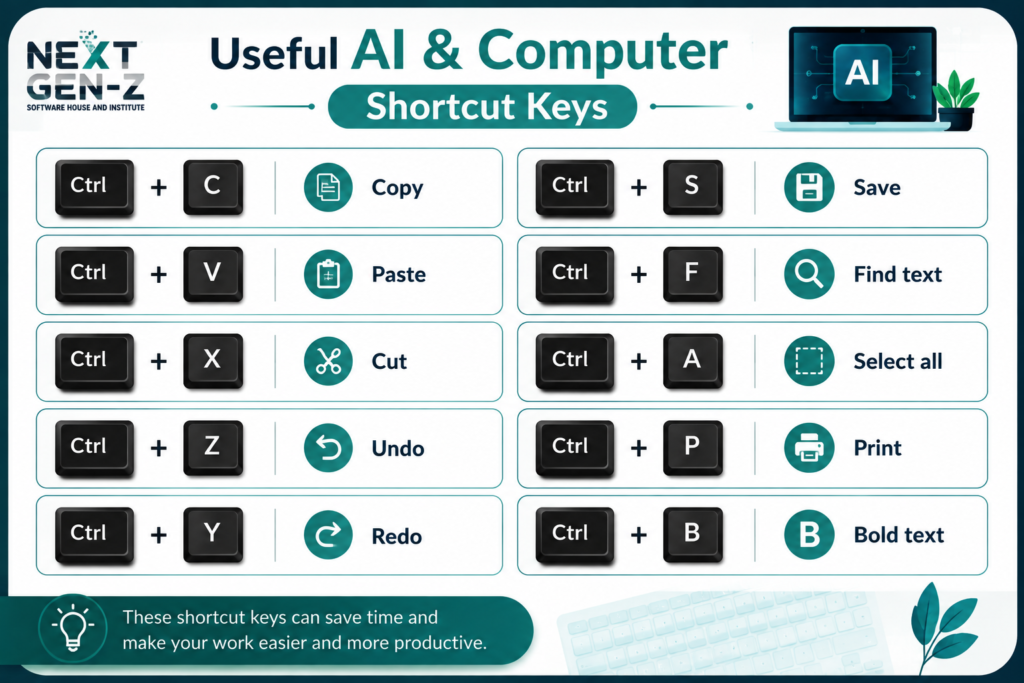
Why Are Shortcut Keys Important?
Keyboard shortcuts help users complete common computer tasks quickly and efficiently. They can save time, reduce repetitive mouse movements, and make everyday work easier. Whether you are studying, writing, designing, or working with AI tools, knowing basic shortcuts can improve your productivity.
💡 Tip: Start by learning a few shortcuts such as Ctrl + C, Ctrl + V, Ctrl + S, Ctrl + Z, and Ctrl + F, then gradually learn more as you use your computer.
Why AI Tools Matter
AI tools are becoming an important part of the digital world. They can help people learn faster, work smarter, create better, and manage everyday tasks more efficiently.
Looking Ahead
The development of AI tools is likely to continue rapidly. New tools and features may appear across education, design, programming, business, research, and communication. Understanding how these tools work today can help people prepare for tomorrow’s digital opportunities.
AI and Human Creativity
Artificial Intelligence can generate ideas, analyze information, and assist with creative tasks, but human creativity remains very important. People bring emotions, experiences, imagination, and personal perspectives that make creative work unique.
AI and Career Opportunities
The growth of AI is creating new opportunities in areas such as AI development, data analysis, cybersecurity, digital marketing, robotics, software development, and AI-assisted design. Learning digital and problem-solving skills can help people adapt to these changes.
AI Literacy
AI literacy means understanding what AI can do, how it works at a basic level, and what its limitations are. Learning AI literacy can help people make better decisions when using AI-powered technologies.
AI and Digital Transformation
AI is an important part of digital transformation. Organizations can use intelligent technologies to improve processes, analyze information, communicate with customers, and develop new digital services.
AI and Innovation
AI encourages innovation by helping researchers, developers, designers, and businesses explore new ideas. It can speed up experimentation and help people find possible solutions to complex problems.
Building Trust in AI
People need to be able to trust the technology they use. Transparency, accurate information, privacy protection, security, and responsible development can help build greater trust in AI systems.
AI and Ethical Responsibility
Responsible AI development requires attention to fairness, privacy, security, transparency, and human oversight. Technology should be designed and used in ways that benefit people and reduce unnecessary risks.
What Should We Learn About AI?
Anyone interested in the future of technology can start with basic concepts such as:
- Artificial Intelligence
- Machine Learning
- Generative AI
- Data Science
- Robotics
- Natural Language Processing
- Computer Vision
- AI Ethics
Final Message
Artificial Intelligence is more than a modern technology trend. It is becoming an important part of the digital world. By learning about AI and using it responsibly, we can take advantage of its opportunities while understanding its limitations.
🌐 AI in the Digital World
Artificial Intelligence is becoming an important part of the digital world. Search engines, mobile applications, online platforms, smart devices, and business systems use AI to analyze information and provide useful services.
📚 AI and Learning
AI can make learning more interactive by explaining difficult concepts, generating practice questions, helping with research, and providing personalized learning support. Students should use AI to understand concepts rather than simply copy answers.
💼 AI and the Workplace
AI can help professionals automate repetitive tasks, organize information, analyze data, and improve productivity. As technology develops, many workplaces may require employees to understand how to work effectively with AI.
🔐 AI and Online Safety
As AI becomes more common, digital safety is increasingly important. Users should protect their passwords and personal information, check suspicious content carefully, and avoid sharing sensitive information with unknown AI tools.
🧠 Human Skills in the Age of AI
Even with advanced AI, human skills remain valuable. Critical thinking, creativity, communication, teamwork, problem-solving, and decision-making can help people use AI more effectively.
🚀 How to Start Learning AI
Beginners can start with basic concepts such as Artificial Intelligence, Machine Learning, Generative AI, and AI tools. Reading reliable resources and practicing with simple projects can gradually build confidence and understanding.
❓ Frequently Asked Questions About AI
What is Artificial Intelligence?
Artificial Intelligence is technology that enables machines and computer systems to perform tasks that normally require human intelligence.
Why is AI important?
AI can help people analyze information, automate tasks, solve problems, and create new possibilities across many industries.
Will AI replace humans?
AI can automate some tasks, but human creativity, judgment, communication, and responsibility remain important.
How can students use AI?
Students can use AI for explanations, brainstorming, practice, research support, and learning new concepts while checking the accuracy of important information.
What is the future of AI?
AI is expected to become increasingly integrated into education, business, healthcare, science, creativity, and everyday technology.
✨ A Small Message for Readers
“Learn AI today, use it responsibly, and prepare yourself for the technology of tomorrow.” 🤖💚
AI and the Future of Society
Artificial Intelligence may influence how people communicate, learn, work, travel, and access services. As AI becomes more common, society will need to balance technological progress with human needs, privacy, fairness, and responsible decision-making.
How Does AI Learn?
AI systems can learn patterns from data. In machine learning, an AI model is trained using examples so that it can recognize patterns and make predictions or generate useful results. The quality and relevance of the data can strongly affect the results.
Generative AI vs Traditional AI
Traditional AI is often designed to perform specific tasks, such as recognizing patterns or making predictions. Generative AI can create new content such as text, images, audio, and other digital material based on its training and instructions.
AI and Automation
AI can work together with automation to handle repetitive processes. This can help organizations save time and allow people to focus more on tasks that require creativity, communication, and decision-making.
Interesting AI Facts
- AI can process huge amounts of information quickly.
- Machine Learning is a major area of AI.
- Generative AI can create different types of content.
- AI is used in education, healthcare, business, transportation, and research.
- AI systems can make mistakes, so important information should be verified.
- Human oversight remains important when using AI.
AI at a Glance
Technology: Artificial Intelligence
Major Areas: Machine Learning, Robotics, Computer Vision, NLP, Generative AI
Uses: Education, Business, Healthcare, Design, Research, Transportation
Main Benefits: Productivity, Automation, Analysis, Innovation
Important Considerations: Privacy, Security, Accuracy, Ethics
What Comes Next?
The next stage of AI will likely focus on making systems more useful, reliable, accessible, and capable of working alongside people. Continuous learning and responsible innovation will be important as AI becomes increasingly connected with everyday technology.
Quick Takeaway
AI is powerful, but the way humans use it matters even more. Understanding its benefits, limitations, and responsible use can help us make better decisions in an increasingly digital world.
AI in Space Exploration
Artificial Intelligence can support space missions by helping analyze scientific data, monitor equipment, and assist researchers in understanding information collected from space. AI can also help make complex space operations more efficient.
AI in Weather Forecasting
AI can analyze large amounts of weather and climate data to identify patterns and improve forecasting. This can help researchers and organizations better understand changing weather conditions.
AI in Manufacturing
Factories can use AI to monitor production systems, identify possible equipment problems, and improve manufacturing processes. AI-powered systems can also help maintain consistent product quality.
AI in Food Technology
AI can support food production by analyzing agricultural information, monitoring supply chains, and helping businesses understand consumer demand. These applications can improve efficiency across different parts of the food industry.
AI in Architecture
Architects and designers can use AI to explore building concepts, analyze designs, and consider different layouts. AI can provide ideas while professionals make the final design decisions.
AI in Energy Management
AI can help analyze energy consumption and identify opportunities to improve efficiency. Intelligent systems can support better management of electricity and other energy resources.
AI in Libraries and Information Management
AI can help organize large collections of digital information, improve search systems, and assist users in finding relevant resources. This can make information easier to discover and manage.
AI in Disaster Management
AI can analyze information from different sources to support disaster monitoring and emergency planning. It may help organizations identify patterns and make faster, informed decisions during emergencies.
AI in Supply Chain Management
Businesses can use AI to analyze inventory, demand, transportation, and other supply-chain information. This can help organizations plan resources more efficiently and reduce unnecessary delays.
AI and Future Research
Researchers are continuing to explore new ways to make AI more accurate, reliable, efficient, and responsible. Future research may lead to new applications that we cannot fully predict today.
A Simple Message for Readers
Artificial Intelligence is developing across many fields, from space exploration and weather forecasting to manufacturing and energy management. Understanding these applications shows how widely AI can influence the future and why learning about this technology is becoming increasingly important.
AI and Personalization
Artificial Intelligence can personalize digital experiences by analyzing user preferences and behavior. This can be seen in recommendations for videos, music, products, news, and online learning resources.
AI in Agriculture
AI can help farmers monitor crops, analyze soil and weather information, detect possible plant problems, and improve the use of water and other resources. This can support more efficient and informed farming.
AI in Retail
Retail businesses can use AI to understand customer preferences, manage inventory, recommend products, and improve online shopping experiences. These applications can help businesses provide more relevant services.
AI in Sports
AI can analyze sports data, player performance, training information, and game patterns. Coaches and athletes can use these insights to better understand performance and develop strategies.
AI in Museums and Cultural Preservation
AI can help organize digital collections, analyze historical information, and support the preservation of cultural materials. Technology can make historical knowledge easier to access and explore.
AI in Human Resources
Organizations can use AI to organize information, automate routine administrative tasks, and support workforce planning. Human professionals should remain responsible for important decisions involving people.
AI and Data Privacy
AI often works with large amounts of information, making data privacy important. Users and organizations should understand how information is collected, stored, and used and should take appropriate steps to protect personal data.
AI and Digital Skills
As AI becomes more common, digital skills will become increasingly valuable. Learning how to evaluate information, write effective prompts, understand AI limitations, and use technology responsibly can help people adapt to the future.
AI and Sustainable Technology
AI can support efforts to reduce waste, improve energy efficiency, monitor environmental conditions, and manage resources. Combining AI with sustainable practices may create more efficient technological solutions.
AI in the Future of Work
The workplace is likely to continue changing as AI becomes more capable. Some tasks may become automated, while new roles and responsibilities may develop. Adaptability, creativity, communication, and continuous learning will remain important skills.
Key Takeaway
Artificial Intelligence is a powerful technology, but its real value comes from how people use it. Responsible use, human creativity, and continuous learning can help turn AI into a useful tool for the future.
Conclusion
Artificial Intelligence is changing the world in remarkable ways. From education and healthcare to business, design, communication, and everyday life, AI is creating new possibilities and making many tasks more efficient. At the same time, it is important to understand that AI has limitations and should be used responsibly.
The future of AI will depend on human creativity, responsible innovation, ethical decisions, and continuous learning. Instead of simply thinking about AI as a replacement for people, we should see it as a powerful tool that can help people learn, create, solve problems, and discover new opportunities.
The future is not just about smarter technology—it is about using technology wisely to build a better future.
Building a Smarter Tomorrow with AI
Artificial Intelligence is opening new possibilities in education, business, healthcare, creativity, and technology. By combining human creativity with intelligent technology, we can create smarter solutions, improve everyday life, and prepare for a better digital future.
“Learn today, innovate tomorrow, and shape the future with AI.”
Conclusion
Artificial Intelligence is no longer just a concept of the future; it has become an important part of the modern digital world. From education, healthcare, business, communication, and design to robotics, transportation, research, agriculture, cybersecurity, and space exploration, AI is creating new possibilities across many fields.
AI tools can help people learn, create, analyze information, automate repetitive tasks, and improve productivity. At the same time, AI has challenges such as privacy concerns, inaccurate information, security risks, bias, and responsible use. This is why human judgment, creativity, critical thinking, and ethical decision-making remain essential.
The future of Artificial Intelligence will depend on how wisely people develop and use this technology. Rather than viewing AI only as a replacement for human work, we can use it as a powerful tool that works alongside people to solve problems, encourage innovation, and create new opportunities.
As AI continues to evolve, learning about its tools, applications, benefits, and limitations can help students, professionals, businesses, and creators prepare for the changing digital world.
The future of Artificial Intelligence is not simply about smarter machines. It is about combining intelligent technology with human creativity and responsibility to build a smarter, safer, and more innovative future. Amazon VA Services